
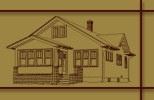

Living and dining rooms: The living room is a fairly good-sized room and is usually connected to the dining room through an arched opening. Usually, both of these rooms would have painted woodwork, including baseboards and the trim of the windows and doors. Many Capes have coved ceilings in the living and dining rooms, making the rooms appear even larger.
Kitchen: Since many Capes were built in the 40’s and 50’s, there are several elements of that era that were integrated into the Capes of the day. For instance, kitchen countertops were treated to new plastic laminates, such as Formica, even though prior to this era, kitchen cabinets didn’t conform to many standards—much less the kitchen itself. Fortunately, researchers at the Building Research Council (University of Illinois at Urbana-Champaign, School of Architecture), created standards for kitchens. Many of these standards were adopted and are still in use today, most notably, the “work triangle” and standard cabinet dimensions.
Windows: A Cape is classified by its double-hung windows throughout the house. It usually also has a bay window in the living room or the dining room, affording the owners a nice view.
Floorplan: There are several standard floorplans for capes, but one of the most popular ones is with the living at the front of the house where the front door enters, dining straight back from the main entry, kitchen off to one side. Between the living and dining is the stairs to go up, and an archway to a hallway opposite of the stairs. In the hallway, one would usually find the bathroom in-between 2 bedrooms, one bedroom at the front, one at the back.