
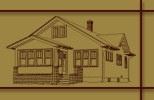

 The Victorian era gets its name from Queen Victoria. In the beginning, the opulence was restricted to the outside of the house because appearances matter, but as the middle class grew, so did the ability to furnish the interiors of these magnificent dwellings that were comparable to their exteriors. Early house-builders drew on what they knew, which was mostly from the other side of the Atlantic. There are several different styles that can be contained under the umbrella term ‘Victorian era home’.
Italianate (see the Italianate section for more information on this style of home).
Gothic: Another popular style in the middle of the nineteenth century, but were initially adapted from the French rather than the British. R. M. Hunt was the architect who went to France in 1846 to observe the architecture there before brining it back to New York. Trademarks of this style included dormer windows, steeply-pitched roofs, parapets and finials—all vertical embellishments. These were highly-expensive homes that only the most rich could afford. The popularity of the style, however, spawned numerous less-elaborate imitations which were more affordable.
Queen Anne: A style which enjoyed its heydays from 1870 until the turn of the century. Scottish-born architect, Richard Norman Shaw was usually identified with this style. He and his acolytes rejected the Gothic style in favor of a more humane style—one which emphasized comfortableness over appearances. The style included projecting oriels, bay windows, and strange rooflines. It also had many different textures including terra-cotta, ornamental plaster, and cut and molded bricks. The house was asymmetrical, and it was built around one central room with a fireplace and built-in inglenooks
Shingle Style: This style is similar to the Queen Anne style but is usually less extravagant. It may be lacking in all the various detail trimwork, and may be more monochromatic. Another feature is that towers usually blend in with the rest of the structure, partially due to the monochromatic look.
French Second Empire / Mansard Victorian: This style of home gets its name from the mansard style roofline. This is a unique roof where the top portion is usually flat, and the shingles face outward at a very steep pitch, almost parallel to the walls. Along with this unique roof configuration, the shingles are usually patterened.
Richardsonian: